

The Week Ahead
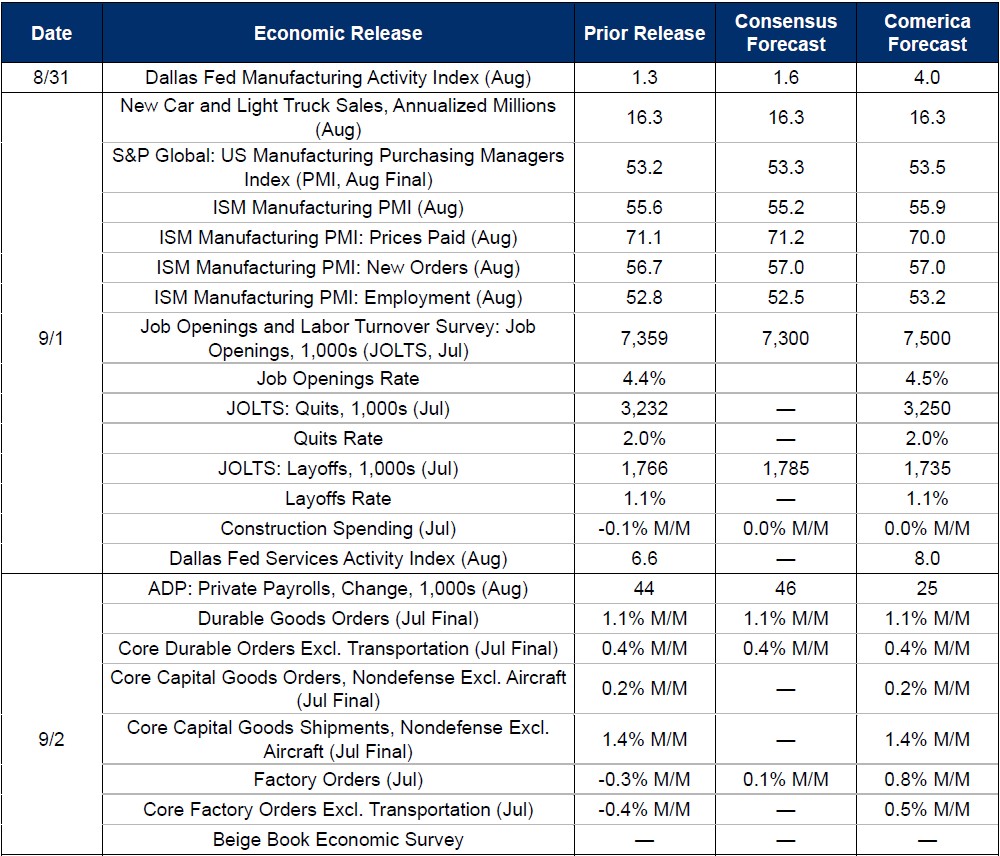
Payrolls likely fell for a second consecutive month in August. The government ended Temporary Protected Status for over 300,000 Haitians on July 27, also canceling their work authorization; 100,000 to 200,000 had been in the labor force. The unemployment rate probably held steady despite lower payrolls because the workers who lost authorization and could no longer seek work would have left the labor force. As a result, the labor force likely contracted again in August after falling 1.3 million over the 12 months through July.
Consecutive monthly payroll declines are rare outside recessions, but these declines are unlikely to signal a downturn. July’s drop largely reflected lower jobs in public education, a volatile category during the summer. Like the end of TPS weighing on August jobs, July’s decline reflected a policy choice—the government employing fewer teachers—rather than a turn in the economic cycle.
The ISM Manufacturing and Services Purchasing Managers Indexes will likely signal continued solid growth in August, another reason that a weak payroll report shouldn’t be viewed as a turn in the economic cycle. Both surveys are likely to report continued high inflation of input costs as the Iran War raises prices for oil, energy products, and petrochemicals, while the AI boom makes semiconductors and electronics more expensive. The surveys are likely to report that a majority of employers added to payrolls in the month, since TPS-related reductions in headcount were probably concentrated in specific industries and regions.
Last Week in Review
Fed Chair Warsh gave a widely anticipated speech at the Fed’s Jackson Hole monetary policy conference on August 28, saying, “We must be confident that underlying inflation is moving to our objective, clearly and at sufficient speed. Otherwise, we have work to do.” His statement indicates a hawkish lean toward interest rates. It also essentially restates the message of the Fed’s last two monetary policy statements: Rate hikes are coming unless inflation slows. Since the Fed held rates steady at the two decisions using that framing, Warsh’s speech reinforces the Fed’s data dependent stance, rather than signaling an imminent hike.
The July PCE inflation report strengthened the case for a hike: Headline inflation held steady at 3.7%, while core inflation excluding food and energy held at 3.3%. Housing has a smaller weight in the PCE price basket than the CPI’s, and healthcare a larger weight, helping explain why PCE inflation is outpacing CPI inflation.
The latest housing data show that while prices are high, their rates of increase are modest: The S&P Cotality Case-Shiller 20-City House Price Index rose 2.1% from a year earlier in June, and the FHFA HPI rose 2.3%. Both trailed growth of average hourly earnings and per capita disposable personal income, meaning affordability is gradually improving. Affordability of new construction is improving even more: The median price of a new house sold fell 0.9% from a year earlier in July as sales fell 6.3% on the year. Sales are down 4.1% year to date. Listings were equivalent to nearly 10 months’ sales at July’s pace, well above the 5.5-month average between 2015 and 2019. High inventories should keep builders competing for market share and restrain new home prices.
For a PDF version of this publication, click here: Comerica Economic Weekly, August 31, 2026
The articles and opinions in this publication are for general information only, are subject to change without notice, and are not intended to provide specific investment, legal, accounting, tax or other advice or recommendations. The information and/or views contained herein reflect the thoughts and opinions of the noted authors only, and such information and/or views do not necessarily reflect the thoughts and opinions of Comerica or its management team. This publication is being provided without any warranty whatsoever. Any opinion referenced in this publication may not come to pass. We are not offering or soliciting any transaction based on this information. You should consult your attorney, accountant or tax or financial advisor with regard to your situation before taking any action that may have legal, tax or financial consequences. Although the information in this publication has been obtained from sources we believe to be reliable, neither the authors nor Comerica guarantee its timeliness or accuracy, and such information may be incomplete or condensed. Neither the authors nor Comerica shall be liable for any typographical errors or incorrect data obtained from reliable sources or factual information.