

The Week Ahead
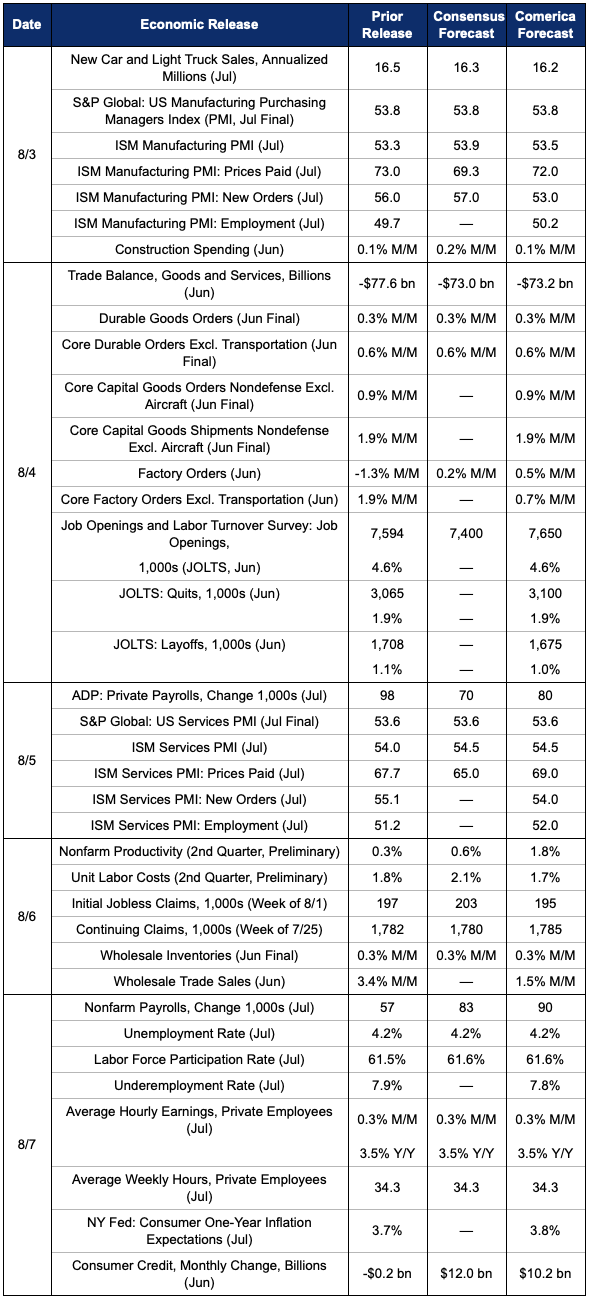
Employers likely added jobs at a moderate pace in July, holding the unemployment rate steady. The labor force participation rate is forecast to edge up from June’s post-pandemic low. Even so, the household survey will likely show that the labor force continues to lag hiring, a trend that will push down the unemployment rate if sustained. Unemployment among recent grads without work experience will likely be lower than at this time last year. Average hourly earnings growth likely held steady. Also out this week, job openings likely rose in the stale May release, while hires and quits are expected to be little changed.
The Institute for Supply Management’s Purchasing Managers Indexes (ISM PMIs) are forecast to show moderate manufacturing growth and brisk services growth in July. Input price inflation is forecast to run hot again in the surveys, and businesses in both sectors will likely report jobs added in the month. Non-farm productivity likely picked up in the second quarter as private output growth outpaced hours worked. Unit labor costs likely rose at a similar pace to the first quarter’s.
Last Week in Review
As expected, the Federal Open Market Committee held the federal funds rate target steady at a range of 3.50% to 3.75% at their July 29 decision. The vote was a 9-3 split, with regional Fed Presidents Hammock, Kashkari, and Logan dissenting in favor of a quarter-percentage-point hike. Chair Warsh played his cards close to his chest in the post-meeting press conference. He welcomed the bond market’s increased sensitivity to economic releases since the Fed’s June decision, which he tried to frame as a helpful result of suspending forward guidance. His framing implies that the Fed’s choice in September between a hike and a hold will be data dependent.
Real GDP had a modest headline in the second quarter, but considerably stronger details. Headline growth slowed to 1.5% annualized and undershot the 2.0% consensus. But real personal consumption expenditures growth picked up to 3.2% annualized, and real final sales to private domestic purchasers (core real GDP) rose 3.9% annualized. This is the report’s most reliable measure of GDP’s trend. Real nonresidential fixed investment rose a robust 8.4% annualized, while real residential fixed investment rebounded to a 1.5% increase after contracting for five straight quarters. Inventories subtracted 0.7 percentage point from real GDP growth. A larger trade deficit subtracted a full percentage point as imports jumped over 11% annualized for a second consecutive quarter. Federal spending subtracted from GDP because of a quirk in its calculation—the report subtracts revenues from Strategic Petroleum Reserve sales from net public spending.
The PCE price index edged down 0.1% in June, matching the consensus forecast, and slowed to a 3.7% year-over-year increase from May’s 4.1%, which was the highest since April 2023. Core PCE inflation excluding food and energy was 0.1% on the month and 3.3% on the year, down a hair from May’s 3.4%. The saving rate fell to 2.7% from May’s downwardly-revised 2.8% and was the lowest since June 2022. Capital gains aren’t included in the BEA’s calculation of personal income, which lowers the saving rate. However, its multi-year low is still a revealing sign of stress on low- and middle-income household budgets, since capital gains mostly accrue to high earners.
For a PDF version of this publication, click here: Comerica Economic Weekly, August 3, 2026
The articles and opinions in this publication are for general information only, are subject to change without notice, and are not intended to provide specific investment, legal, accounting, tax or other advice or recommendations. The information and/or views contained herein reflect the thoughts and opinions of the noted authors only, and such information and/or views do not necessarily reflect the thoughts and opinions of Comerica or its management team. This publication is being provided without any warranty whatsoever. Any opinion referenced in this publication may not come to pass. We are not offering or soliciting any transaction based on this information. You should consult your attorney, accountant or tax or financial advisor with regard to your situation before taking any action that may have legal, tax or financial consequences. Although the information in this publication has been obtained from sources we believe to be reliable, neither the authors nor Comerica guarantee its timeliness or accuracy, and such information may be incomplete or condensed. Neither the authors nor Comerica shall be liable for any typographical errors or incorrect data obtained from reliable sources or factual information.