

The Week Ahead
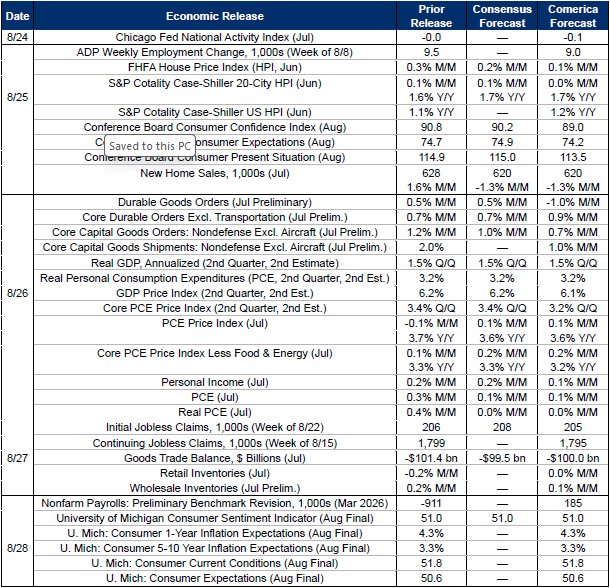
The Fed’s preferred measure of core inflation (Core PCE prices less food and energy) likely slowed slightly in July, helped by downward revisions to the second quarter. Total PCE inflation likely improved more than core because gas prices fell, but that’s cold comfort since they are up again in August. Personal consumption expenditures and personal incomes likely grew modestly in July, but were about flat after accounting for inflation.
Payroll employment will likely be revised slightly higher in the preliminary benchmark revision to its level in March 2026. The revision uses data from the Quarterly Census of Employment and Wages (QCEW). The QCEW directly measures employment much more comprehensively than the survey of establishments that the Bureau of Labor Statistics uses for the monthly payrolls report. The biggest gap that the QCEW fills in relative to the monthly establishment survey is the number of jobs added at newly-opened workplaces and lost at closing ones. New workplaces aren’t yet on the government’s list to survey, and the statisticians can’t tell in real time whether an employer that doesn’t respond to the survey has closed shop or is just slow to report. The revision will likely paint a slightly better picture of job growth in 2025 and early 2026, but not enough to change the job market’s high-level narrative: Job growth has picked up in 2026 after a weak 2025.
No major revisions are expected to the second quarter’s headline real GDP growth in the second estimate. Residential investment will likely be revised lower, offset by upward revisions to nonresidential investment in structures and equipment, and to investment in inventories.
Last Week in Review
The minutes of the Fed’s late-July meeting reinforced our view that the Federal Open Market Committee wants to see core inflation lower to persuade them against a rate hike at one of the next few meetings, writing, “Many participants assessed that policy tightening would likely be necessary if inflation did not decline.” Inflation narrowly met that bar in July. August may be a different story: Gas prices rose at the pump, and diesel was within a dime per gallon of the highest since the war broke out.
Housing disappointed in July. Housing starts fell 12.4% to the second lowest since 2020. Units completed fell to the lowest since 2020. Permits were better, but similar to other indicators in the year to date: down 0.6%, with single-family down 3.2% while 5+ unit multifamily permits rose 5.7%. Pending home sales were weaker than expected in July, too, falling 2.3% and down 2.5% from a year earlier.
Industrial production was better, up 0.2% in July. Utilities rose 0.5% as the U.S. experienced the hottest July temperatures on record. Manufacturing and mining output both rose 0.2%. The AI boom is fueling demand for electronics, electrical equipment, and construction materials used to build data centers. Demand for defense-related products is strong, too. These strengths offset weakness in consumer durables. Capacity utilization rose to 76.3% from 76.2% and was the highest since July 2025. With housing soft and manufacturing firming, 2026 will be a middling year for U.S. goods-producing sectors—high long-term interest rates are capping their growth.
For a PDF version of this publication, click here: Comerica Economic Weekly, August 24, 2026
The articles and opinions in this publication are for general information only, are subject to change without notice, and are not intended to provide specific investment, legal, accounting, tax or other advice or recommendations. The information and/or views contained herein reflect the thoughts and opinions of the noted authors only, and such information and/or views do not necessarily reflect the thoughts and opinions of Comerica or its management team. This publication is being provided without any warranty whatsoever. Any opinion referenced in this publication may not come to pass. We are not offering or soliciting any transaction based on this information. You should consult your attorney, accountant or tax or financial advisor with regard to your situation before taking any action that may have legal, tax or financial consequences. Although the information in this publication has been obtained from sources we believe to be reliable, neither the authors nor Comerica guarantee its timeliness or accuracy, and such information may be incomplete or condensed. Neither the authors nor Comerica shall be liable for any typographical errors or incorrect data obtained from reliable sources or factual information.