

The Week Ahead
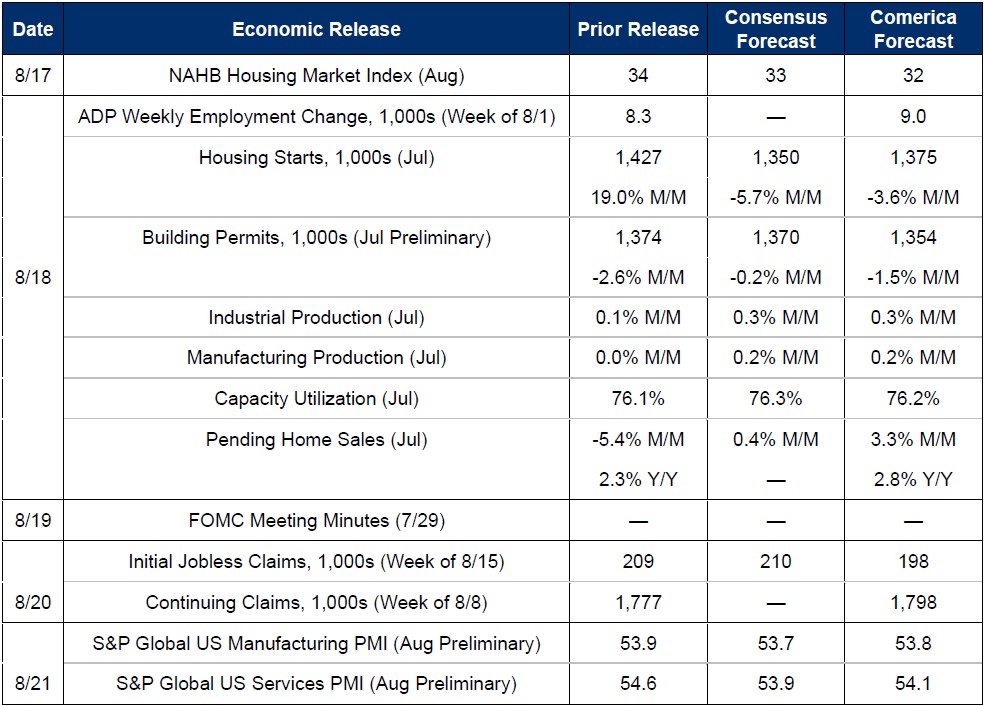
The minutes of the Federal Open Market Committee’s July meeting are expected to show that inflation remains policymakers’ foremost consideration ahead of the next decision. The committee wants evidence that inflation is trending lower—i.e., lower core inflation—to feel comfortable refraining from a rate hike. The July CPI and PPI reports narrowly met that bar, but are not the last word since the August CPI and PPI reports will be released before the September meeting. Industrial production is forecast to grow solidly in this release as the hottest July on record fueled utility demand. Manufacturing output likely rose moderately, supported by strong demand for defense products and the electronic, electrical, and construction materials used in data centers. Pending home sales likely rebounded after a drop in June, and rose moderately from a year earlier. The Services PMI published by S&P Global likely pulled back in the August preliminary release after the boost from the World Cup faded. .
Last Week in Review
The CPI rose 0.1% in July and matched the consensus forecast. In year-over-year terms, it edged down to 3.4% from 3.5% in June, but still outpaced July’s 3.2% increase of average hourly earnings. While gas prices fell 2.9%, they are still up 24.6% year over year after surging in the spring. Food prices edged up 0.1%, and are up 3.0% from a year earlier. Like gas prices, beef and veal prices dipped on the month but are up sharply on the year (9.4%).
Core CPI less food and energy rose 0.2%, also matching consensus. Year over year, it edged down to 2.5% from June’s 2.6%. Within core goods, new vehicles rose 0.1% while used cars and trucks rose 0.4%. Medical care commodities fell 0.6%, helped by lower prescription drug prices. Within core services, shelter edged up 0.1%. Rent of primary residence and owners’ equivalent rent both rose 0.3%, while the shelter segment including hotels and motels fell 3.3% as the World Cup ended. Airline fares rose 2.2%. Labor-intensive services posted more outsized increases. From a year earlier, gardening and lawncare jumped 12.3%, home health care rose 9.7%, nursing home and adult day care rose 4.2%, and day care and preschool rose 3.4%, all outpacing Core CPI and average hourly earnings. The PPI was unchanged in July, below consensus, while Core PPI less foods and energy rose 0.2%. Both total and Core PPI slowed considerably in year-over-year terms. The most important detail of the PPI report was a 6.5% jump in portfolio management services, a component that feeds into Core PCE.
In short, inflation improved in July but is still straining household budgets. July was the fourth month running in which average hourly earnings growth lagged CPI inflation. Inflation could worsen again near-term, since gasoline prices are up so far in August from July. If the energy price shock fades, slowing shelter inflation would be the most positive factor in the inflation outlook. Inflation from labor-intensive services would be the biggest negative factor given the ongoing contraction of the labor force.
Retail and food services sales were considerably weaker than expected in July, falling 0.6%. Core sales excluding gas stations and motor vehicle and parts dealers fell 0.3%. Lower gas prices and the shifting of Amazon Prime Day to earlier in the summer explain some of July’s weakness. But the report suggests that high gas prices are straining household budgets enough to slow consumer spending growth.
For a PDF version of this publication, click here: Comerica Economic Weekly, August 17, 2026
The articles and opinions in this publication are for general information only, are subject to change without notice, and are not intended to provide specific investment, legal, accounting, tax or other advice or recommendations. The information and/or views contained herein reflect the thoughts and opinions of the noted authors only, and such information and/or views do not necessarily reflect the thoughts and opinions of Comerica or its management team. This publication is being provided without any warranty whatsoever. Any opinion referenced in this publication may not come to pass. We are not offering or soliciting any transaction based on this information. You should consult your attorney, accountant or tax or financial advisor with regard to your situation before taking any action that may have legal, tax or financial consequences. Although the information in this publication has been obtained from sources we believe to be reliable, neither the authors nor Comerica guarantee its timeliness or accuracy, and such information may be incomplete or condensed. Neither the authors nor Comerica shall be liable for any typographical errors or incorrect data obtained from reliable sources or factual information.