

Summary
- Canadian dollar gains on stronger-than-expected GDP report on Monday, gives back a small portion today as trade worries rise.
- The U.S. dollar steady today, but down every day this week previously.
- ADP November private payrolls unexpectedly fell by 32,000, led by steep small business job cuts.
- BMO, Goldman Sachs position in U.S. for Fed to ease later this month.
- Japan’s yen appreciates as traders consider the Bank of Japan’s path and is considered the only currency with the potential for extreme volatility this by months’ end.
- Yen strengthens to 1-month high below 155 per U.S. dollar as Japan’s 10-year bond yield hits 1.905%, highest level since 2007.
- U.S. Treasury yield remains above 4% on the benchmark 10-year bond yield, currently at 4.09% after touching 3.96% last Friday.
- Mexico peso rangebound near 18.25 per one U.S. dollar.
- U.S. jobless claims 191,000 in November 29 week vs. 220,000 forecasts. This is the lowest reading since 2022.
- BNP sees euro rallying, Japanese yen reeling, and U.S. dollar steady in 2026.
- China’s yuan (CNH) advanced to 14-month high amid dollar weakness.
Noteworthy
- U.S. Dollar Suffers Worst Seven-Day Stretch Since 2020
- U.S. Weekly Jobless Claims Fall to 3-Year Low
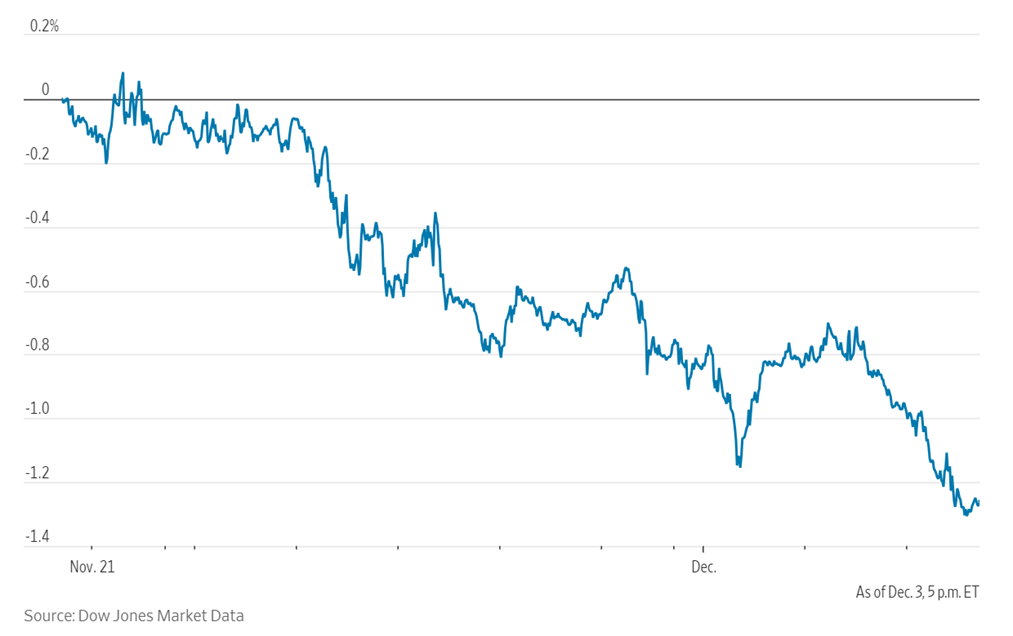
The U.S. dollar is suffering its longest losing streak in years. The Dollar Index has fallen for seven consecutive trading days, its most prolonged slide since July 2020, according to Dow Jones Market Data. The index dropped 0.4% in Wednesday trading.
Traders may be trimming dollar exposure as it looks increasingly likely that President Trump will select Kevin Hassett as the next chair of the Federal Reserve, wrote David Morrison, senior market analyst at Trade Nation, in a morning note. “Mr. Hassett has made it clear that he favours lower interest rates.”
On top of that, the likelihood of a rate cut at the Fed’s Dec. 10 meeting has risen over the last few weeks, according to interest-rate futures prices tracked by CME FedWatch. Investors now believe a cut is highly likely. Lower rates generally decrease the value of a country’s currency.
Overseas the euro currency rose on the weak dollar performance and steady European Central Bank (ECB) interest rate expectations. Specifically, the euro currency rose to a near seven-week high against the dollar, supported by Federal Reserve interest-rate cut bets ahead of the Dec. 10 policy decision.
While the move is largely driven by a weaker dollar, recent euro-zone data and comments from European Central Bank President Christine Lagarde are also providing support, Europe analysts say in a note. The final euro-zone services purchasing managers’ index for November was revised higher and November inflation data were broadly in line with the ECB’s 2% target. Meanwhile, Lagarde has recently suggested no policy shifts.
These factors are keeping ECB expectations steady, supporting the euro’s fundamental backdrop. The euro rose to a high near $1.1700, London Stock Exchange Group (LSEG) data show.
Elsewhere, the U.K. pound sterling eased slightly but stayed close to one-month highs reached earlier against the euro currency and the U.S. dollar. A weaker dollar on prospects of U.S. interest-rate cuts has lifted sterling, which was helped additionally by an unexpected upward revision to November’s U.K. services purchasing managers’ index on Wednesday. “The better-than-expected Purchasing Manager’s Index (PMI) release point to a better momentum for the U.K. economy towards the end of the year,” Danske Bank said in note. The relative growth backdrop between the euro-area and U.K. has become more positive for sterling versus the euro, the note stated. The euro currency is last up 0.1% at 0.8751 pounds after hitting a low of 0.8731 overnight. Sterling was steady slightly below $1.34.
In Asia, some traders predict that Japanese equities, yen could perform well in 2026. The yen and Japanese equities are poised to perform well next year, and Japanese government bonds should outperform most developed-market peers in common-currency terms, says Thomas Mathews, Asia-Pacific head of markets at Capital Economics, in a note. He cites three reasons for optimism:
Firstly, corporate earnings will likely remain resilient as U.S. tariff risks subside and corporate reforms bear fruit. Secondly, fiscal concerns seem overblown, with Japan potentially posting a budget surplus this year. Finally, cheap valuations in the MSCI Japan index and the yen suggests sentiment is too downbeat and could reverse sharply. Still, Mathews notes strong profits could fuel wage gains and trigger further Bank of Japan (BoJ) tightening, pressuring government bonds. A potential yen rally could also pose headwinds for domestic equities, he added.
Change in U.S. Dollar Index, past ten days
Contact Comerica Foreign Exchange
This publication has been prepared for general educational/informational purposes only and should not be considered as investment advice or a recommendation for any particular security, strategy or investment product, or as personalized investment advice. The information contained herein has been obtained from sources believed to be reliable, but Comerica does not represent, or guarantee, its completeness or accuracy. The views expressed herein are solely those of the author(s) at the time of publication. Comerica will not be responsible for updating any information contained within this publication, and such information is subject to change without notice. Comerica does not assume any liability for any direct, indirect or consequential losses that may result from reliance upon this publication.